
Thinking Outside the Skull: Why Your Next "Brain" Won't Be Biological
Psych 🧠 - 468/500
Hello reader,
We’ve always used tools to think better like pen and paper, books, calculators, search engines. But something strange is happening now: the tools are starting to talk back.
Instead of just storing information, they’re helping us think with them. This paper explores exactly that shift.
What is it?
This research introduces the idea of “Three-Brain Thinking”, arguing that large language models (LLMs) like ChatGPT function as a third, external cognitive organ i.e. not biological, but capable of participating in human reasoning.
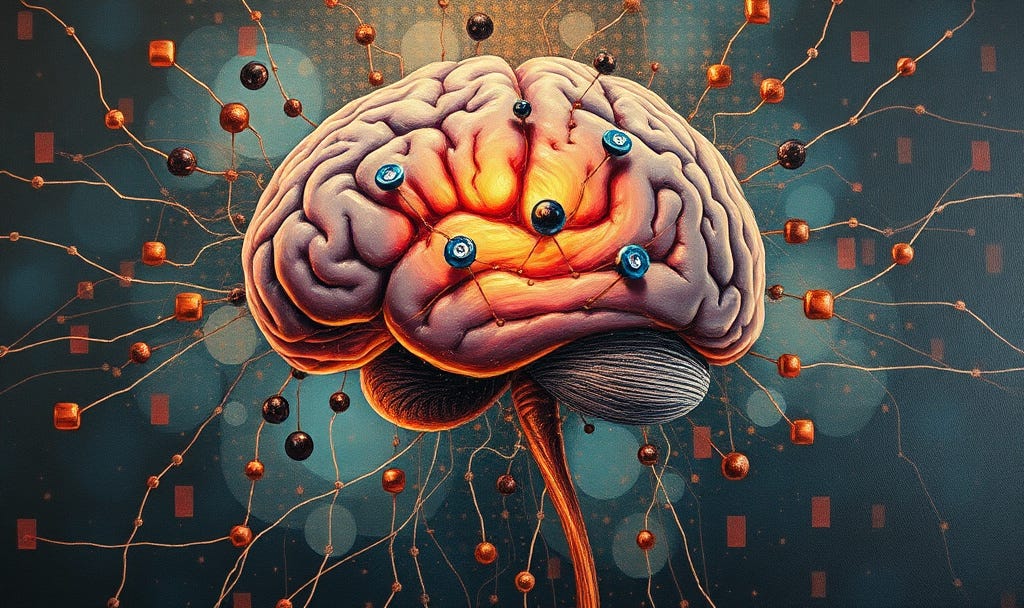
Traditionally, cognition has been understood as a cooperation between the cerebrum (deliberative, reflective thinking) and the cerebellum (fast, automated optimization). The author proposes that advanced AI now forms a third cognitive locus: an extracorporeal system that can organize, transform, and refine ideas through language-based interaction
Key Findings:
LLMs function as extracorporeal cognitive organs, not just tools.
Human cognition is shifting toward a distributed architecture across brain and machine.
Co-reflective dialogue enables iterative idea refinement, not one-shot answers.
The paper introduces “reverse supervised learning”, where humans learn by converging toward machine-generated semantic representations.
AI accelerates ideation by reducing cognitive drag (summarizing, reframing, counter-arguing).
This framework extends Extended Mind Theory into modern human–AI interaction.
You NEED to check out this psychology handbook!👇
This Handbook explains 150+ biases & fallacies in simple language with emojis.
Or the Amazon Kindle copy from here.
What do I need to know:
AI does not need consciousness or understanding to meaningfully support thinking.
This is about offloading reflection, not surrendering agency or creativity.
Co-reflection works best when humans retain judgment, goals, and ethical oversight.
The model explains why AI feels like a “thinking partner,” not a calculator.
Creativity may increase, not decrease, as idea-generation becomes less cognitively taxing.
Education, research, and knowledge work will increasingly rely on human-AI dialogue.
Source:
https://papers.ssrn.com/sol3/papers.cfm?abstract_id=5765782
Fascinating reframe of cognition distribution. The three-brain model clarifies why LLM interactions feel less like tool use and more like externalised thinking. What's particularly interesting is how the cerebelum handles automated optimization while LLMs handle reflective reframing, creating a cognitive division of labor that our biology alone couldn't achieve. I've experienced this in research where offloading synthesis to AI freed up cerebral resources for higher-order critique.